What is tokenization? Real-world assets on a blockchain
Tokenization turns bonds, fund shares, property or stocks into blockchain tokens. How it works, the main types, who uses it, the real benefits and the risks.
CryptoGroup Newsroom · · 7 min read
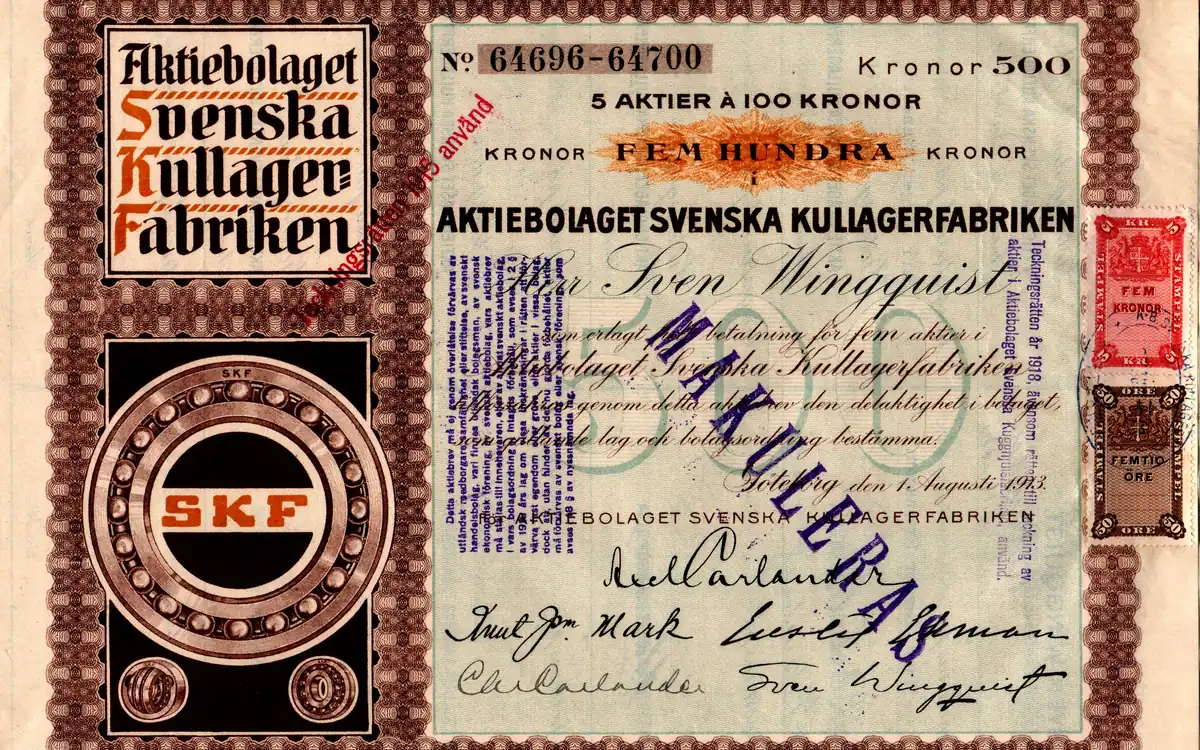
Tokenization means issuing a digital token on a blockchain that stands for ownership of, or a claim on, something that exists outside it: a government bond, a share in a money market fund, a slice of an office building, a stock or a bar of gold. The asset itself usually stays where it is, with a custodian or registrar; the token is a new way to record who owns it and to move that ownership around.
The idea is not new in spirit. Paper share certificates, like the 1913 one in the photo above, were once the record of ownership; later they became entries in electronic databases. Tokenization swaps that database for a shared ledger that anyone with the right permissions can read and settle on at any hour.
How tokenization works
Most tokenized assets follow the same basic steps:
- An asset is placed with a custodian. A fund manager buys Treasury bills, a property company puts a building into a legal entity, or a broker holds shares at a depository.
- An issuer creates tokens on a blockchain such as Ethereum, Solana, the XRP Ledger or a private bank chain. Each token is tied to a fixed amount of the asset, often 1:1.
- Rules are written into the token. Smart contracts can restrict transfers to verified (KYC'd) wallets, pay out interest or dividends, and freeze tokens on a court order.
- Tokens trade or move. Holders can transfer them peer to peer, post them as collateral or redeem them with the issuer for cash or the underlying asset.
The key question is always the legal wrapper. In some products the token is the legal record of ownership. In others it is only a mirror of a traditional record kept elsewhere, or a claim on a company that holds the asset. That difference decides what you get if something goes wrong.
What gets tokenized
| Asset | What the token represents | Typical holders |
|---|---|---|
| Treasuries and money market funds | Fund shares backed by short-term government debt | Crypto firms, DAOs, treasuries, funds |
| Stocks and ETFs | A share held by a broker or depository, or a derivative tracking it | Retail traders outside the US, institutions |
| Private credit | Loans to companies, pooled into a fund | Yield-seeking crypto investors |
| Real estate | Shares in a company or fund that owns property | Retail and accredited investors |
| Commodities | A claim on gold or other metal in a vault | Retail and institutions |
Treasuries lead by a wide margin. Chainalysis puts the tokenized US Treasury market at $15.42 billion, about 42.8% of all tokenized real-world assets, after growing 125% in a year, and found that most of its geolocated value sits with holders outside the US. Fund firms are active too: Franklin Templeton recently added $150 million of fund tokens on the XRP Ledger, and Ondo Finance says its tokenized assets have passed $4 billion.
Stocks are growing fast but are the most contested. Our guide to tokenized stocks explains the three main models. Some listed companies have objected to their shares being tokenized without consent, as shown by the objections to OKX's tokenized stock plan.
Property is the oldest pitch and the hardest to get right, because land registries, local law and illiquid buildings do not move at blockchain speed. Latvia, for example, wants rules for tokenizing commercial property in 2027.
Why institutions care
The loudest promises (fractional ownership of everything, instant global markets) matter less to banks than plumbing:
- Faster settlement. Trades can settle in minutes instead of a day or more, which frees up cash and reduces the risk that a counterparty fails in between.
- Always-on markets. Tokens move at weekends and at night, when traditional settlement systems are closed.
- Better collateral. A tokenized bond can be pledged and returned within hours. Broadridge's blockchain repo platform handled an average of $359 billion a day in September, as we covered in our report on tokenized repo.
- Programmability. Interest payments, transfer limits and compliance checks can run automatically.
Market infrastructure is joining in. The US Depository Trust & Clearing Corporation (DTCC) is launching a service that turns 25 stocks, ETFs and Treasuries into tokens backed 1:1 by securities it holds, while keeping itself as the official record keeper.
Tokenization vs stablecoins and crypto
A stablecoin is the best-known tokenized asset: a token backed by dollars and short-term bonds. The difference is that a stablecoin aims to stay at $1 and is used as money, while a tokenized fund or bond passes its yield, and its price changes, to the holder. Bitcoin and ether are different again: they are native to their blockchains, with nothing off-chain behind them.
The risks
+ Pros
- Faster, cheaper settlement and fewer middlemen
- Transfers and redemptions outside banking hours
- Smaller minimum investments for some products
- Assets can be used as on-chain collateral
− Cons
- You rely on the issuer and custodian actually holding the asset
- Legal rights can be weaker than owning the asset directly
- Smart-contract bugs, hacks and lost keys
- Many tokens can only be sold to verified buyers or redeemed with the issuer
- Issuer and custody risk. If the company behind the token fails, your claim depends on how the asset was ring-fenced. Read who the custodian is and whether assets are held in a bankruptcy-remote structure.
- Liquidity. A token that trades 24/7 is only liquid if there are buyers. Many products allow resale only to whitelisted wallets.
- Regulation. In the US, tokenized securities are still securities. In the EU, MiCA covers most crypto assets but tokenized financial instruments fall under existing securities law; our MiCA guide explains the split.
- Technology. Tokens live in wallets, so the usual rules apply: protect your keys and beware of fake token contracts.
How to evaluate a tokenized asset
Before buying any tokenized product, check five things: what exactly the token gives you (ownership, a debt claim or price exposure only), who holds the underlying asset, how and when you can redeem, which blockchain and wallet it needs, and which regulator, if any, oversees the issuer. If the answers are vague, treat the token as you would any unregulated crypto asset.
Frequently asked questions
What is tokenization in simple terms?
It is creating a token on a blockchain that represents ownership of, or a claim on, a real-world asset such as a bond, fund share, building or stock, so that ownership can be recorded and transferred digitally.
What are tokenized real-world assets (RWAs)?
RWAs are tokens backed by assets that exist off-chain. The largest category is tokenized US Treasuries and money market funds, followed by private credit, commodities like gold, and stocks.
Is tokenization the same as a stablecoin?
A stablecoin is one kind of tokenized asset, designed to hold a fixed value such as $1. Tokenized funds and bonds instead pass their price changes and yield on to holders.
Is tokenization safe?
It depends on the product. The main risks are the issuer or custodian failing, weak legal rights to the underlying asset, smart-contract bugs and limited resale options. Check who holds the asset and how redemption works.
Can anyone buy tokenized assets?
Not always. Many tokenized securities are restricted to verified or professional investors, or are unavailable in certain countries, including the US for some tokenized stocks.
This article is for information only and is not financial advice. Crypto assets are volatile; do your own research. Read our disclaimer
More from Markets
View all →Read next

ECB's Cipollone: digital euro is about payments sovereignty
ECB board member Piero Cipollone says the digital euro would cut Europe's reliance on foreign payment firms. Staff pilot in 2027, launch as early as 2029.

Circle Match: USDC redeemers now pay a rebate to minters in hourly auctions
Circle's new Match service pairs institutions cashing out of USDC with those minting it. Redeemers pay one fee capped at the Express rate; minters get it.
What is Polkadot (DOT)? How it works, staking and risks
Polkadot explained: how its relay chain and rollups share security, what the DOT token is used for, the new 2.1 billion supply cap, staking and the main risks.