What is Zcash (ZEC)? How its shielded privacy works
Zcash explained: how shielded and transparent addresses work, zk-SNARKs, the 21M ZEC supply, the 2026 Orchard bug and Ironwood fix, and Zcash vs Monero.
CryptoGroup Newsroom · · 8 min read
Zcash is a cryptocurrency that works much like bitcoin — a fixed supply, mining and a public blockchain — but lets users make payments in which the sender, the receiver and the amount are encrypted. It launched on Oct. 28, 2016, and its coin, ZEC, has become the best-known "privacy coin" next to Monero. This explainer covers how Zcash's privacy works, how the coin is issued, what changed in 2026 and the risks. It is educational, not investment advice.
Where Zcash came from
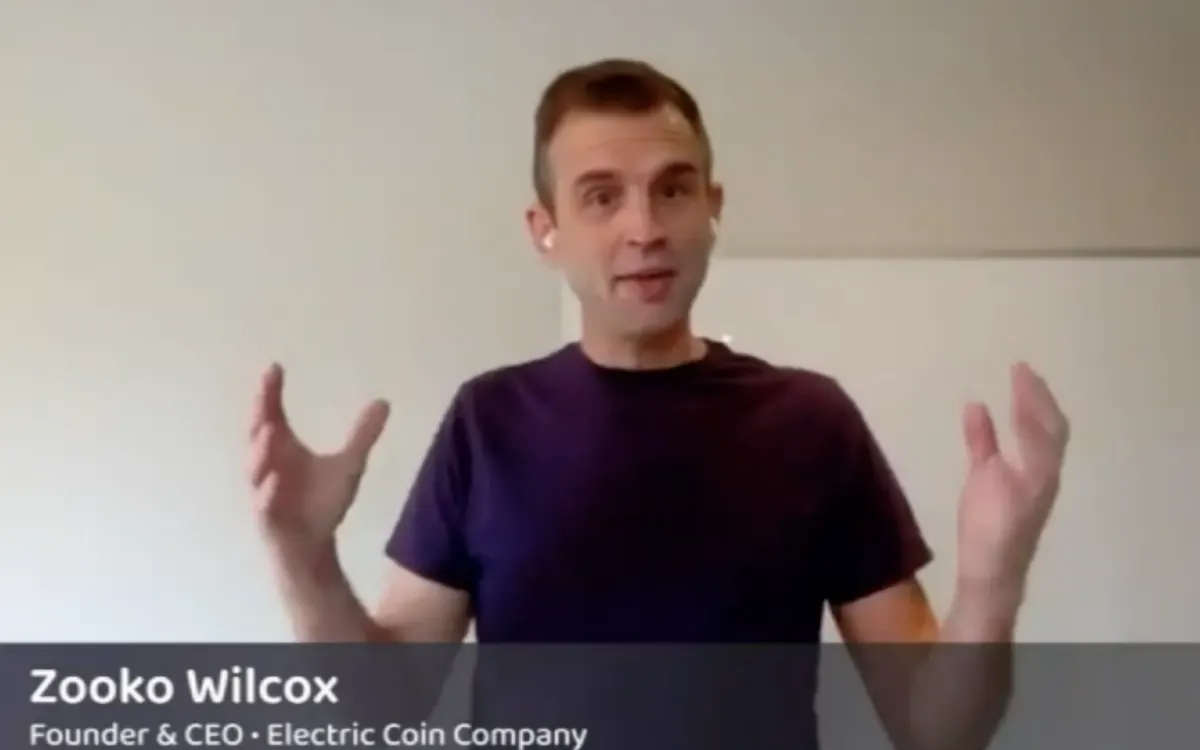
Zcash grew out of academic work on Zerocash, a 2014 research paper on adding strong privacy to a bitcoin-style currency. A team led by Zooko Wilcox-O'Hearn turned it into a live network through a company then called the Electric Coin Company. Today development is spread across several groups, including the Zcash Foundation, Shielded Labs, the Zcash Open Development Lab (ZODL) and the team behind the newer Zakura node.
Bitcoin's ledger is public: anyone can follow coins from address to address, and chain-analysis firms do exactly that. Zcash's goal was to keep a public, verifiable ledger while letting users hide the details of their payments.
How shielded transactions work
The core tool is a zero-knowledge proof, specifically a zk-SNARK. When you send a shielded payment, your wallet produces a short mathematical proof that says, in effect, "this transaction spends coins that exist, hasn't spent them before and creates no new money" — without revealing which coins, who received them or how much moved. Nodes check the proof instead of the details.
Zcash has two kinds of addresses:
- Transparent addresses (starting with "t") work like bitcoin addresses. Balances and transfers are visible on-chain.
- Shielded addresses keep funds in an encrypted shielded pool. Modern wallets show a unified address (starting with "u1") that bundles several receiver types so the sender's wallet can choose the most private option.
Payments between two shielded addresses reveal almost nothing publicly. Moving coins between the transparent and shielded sides is visible as an amount crossing the boundary, which is one way privacy can leak if you shield and unshield the same sum quickly.
Viewing keys let you share read-only access to your shielded history with an auditor, an accountant or a tax authority, without giving anyone the ability to spend. Spending still requires the private spending key; see our explainer on what a private key is.
Supply, mining and upgrades
ZEC has the same 21 million maximum as bitcoin. About 17 million had been issued by late October 2026. New coins are mined with proof of work using the Equihash algorithm, and the block reward halves roughly every four years — most recently in November 2024, to 1.5625 ZEC per block. Since 2020 part of each block reward has gone to development funding; under current rules a share accrues to a protocol "lockbox" that coinholders vote to spend. Our guide to proof of work vs proof of stake explains how mining secures a chain like this.
Zcash changes its rules through numbered network upgrades (NU). The next one, NU7, is set for around Nov. 5, 2026: it cuts block times from 75 to 25 seconds and closes the oldest shielded pool, Sprout — see our report on NU7's 25-second blocks.
Key moments
Oct 2016
Launch
Zcash mainnet goes live with the Sprout shielded pool.
Oct 2018
Sapling
Much faster shielded transactions make private payments practical on phones.
May 2022
Orchard (NU5)
Halo 2 proofs remove the need for a trusted setup ceremony; unified addresses arrive.
Jun 2026
Orchard bug fixed
An emergency upgrade (NU6.2) patches a soundness flaw found in late May.
Jul 2026
Ironwood (NU6.3)
A new, formally verified shielded pool opens and Orchard is sealed.
The 2026 Orchard bug and Ironwood
On May 29, 2026, security researcher Taylor Hornby found a soundness flaw in the code for Orchard, then the main shielded pool. In theory it could have let someone spend the same funds twice inside Orchard. Developers disabled Orchard within days and switched on a corrected version with the NU6.2 upgrade on June 3. They say there is no evidence the bug was exploited, and Zcash's turnstile — an accounting rule that stops more ZEC leaving a pool than entered it — protects the total supply.
Because Orchard's contents are encrypted, nobody could prove from the inside that no fake coins were created. The Ironwood upgrade (NU6.3, July 28, 2026) answered that: it sealed Orchard, opened a new pool built on the corrected and formally verified circuit, and forces funds to leave Orchard through the turnstile. According to the ZecStats tracker, about 90% of Orchard's balance had moved by late October and roughly 29% of all issued ZEC was shielded.
Zcash vs Monero vs Bitcoin
| Zcash (ZEC) | Monero (XMR) | Bitcoin (BTC) | |
|---|---|---|---|
| Privacy | Optional, shielded via zk-SNARKs | On by default for every transaction | None by default; public ledger |
| Supply | 21M cap | No hard cap; small fixed tail emission | 21M cap |
| Consensus | Proof of work (Equihash) | Proof of work (RandomX, CPU-friendly) | Proof of work (SHA-256) |
| Selective disclosure | Viewing keys | View keys | Not needed; already public |
The practical difference: on Monero everyone is private by default, which makes the crowd you hide in bigger. On Zcash you choose, which keeps it easier for exchanges to support but means privacy depends on how many people actually use the shielded pools.
Regulation, exchanges and ETPs
Privacy coins face more scrutiny than other crypto. Some exchanges have delisted ZEC in certain countries, and some only support transparent addresses for deposits and withdrawals, so check before sending from a shielded wallet. In the EU, new anti-money-laundering rules will restrict how crypto firms handle anonymity-enhancing coins from 2027; for the broader framework see what is MiCA.
At the same time, ZEC has entered mainstream wrappers. Grayscale runs a Zcash ETF in the U.S. that recently posted its best week of inflows since September, and several European issuers list Zcash ETPs — although Euronext halted CoinShares' new Zcash ETP on its debut day over settlement issues. Our guide to crypto ETFs, ETPs and ETNs explains what you actually own in each.
Risks to know
- Price volatility: ZEC has moved by large percentages in short periods, even by crypto standards.
- Protocol risk: the 2026 Orchard flaw showed that complex cryptography can hide bugs; upgrades reduce but don't remove that risk.
- Access risk: delistings or restrictions can make ZEC harder to buy or sell in some places.
- Future threats: like most chains, Zcash relies on elliptic-curve cryptography; developers are already working on quantum resistance — see Zakura's per-swap keys and our explainer on whether quantum computers can break bitcoin.
Frequently asked questions
What is Zcash used for?
Zcash is used as digital money with optional privacy. Shielded payments hide the sender, receiver and amount, while transparent payments work like bitcoin transactions.
Is Zcash anonymous?
Only when you use shielded addresses, and even then exchanges, network data and usage patterns can reveal links. Transparent Zcash transactions are as public as bitcoin's.
How many Zcash coins are there?
The maximum supply is 21 million ZEC. About 17 million had been issued by late October 2026, and the block reward halves roughly every four years.
What is the difference between Zcash and Monero?
Monero makes every transaction private by default, while Zcash lets users choose between shielded and transparent transactions. Zcash also has a 21 million cap; Monero has a small permanent tail emission.
Was Zcash hacked in 2026?
No known exploit occurred. A soundness bug in the Orchard pool was found in May 2026 and fixed in early June; developers say there is no evidence it was used, and the Ironwood upgrade lets anyone verify the supply.
Is Zcash legal?
Holding ZEC is legal in most countries, but some exchanges restrict or delist privacy coins, and EU rules from 2027 limit how crypto firms can handle them. Check the rules where you live.
This article is for information only and is not financial advice. Crypto assets are volatile; do your own research. Read our disclaimer
More from Altcoins
View all →Read next

Euronext halts CoinShares Zcash ETP on debut day
Euronext suspended CoinShares' Zcash ETP (ZCSH) in Paris on the day it was due to list, citing settlement support at the central securities depository.

Google previews MPC crypto custody service for banks
Google Multi-Party Compute splits private keys across separate systems and checks policy before signing. It is in private preview, with launch set for early 2027.

OKXICE objections hit 33: JPMorgan, Coca-Cola, Dell opt out
JPMorgan, Coca-Cola, Dell and four more firms objected to tokenized trading of their shares on OKXICE, lifting the total to 33 and nearly half the first list.